
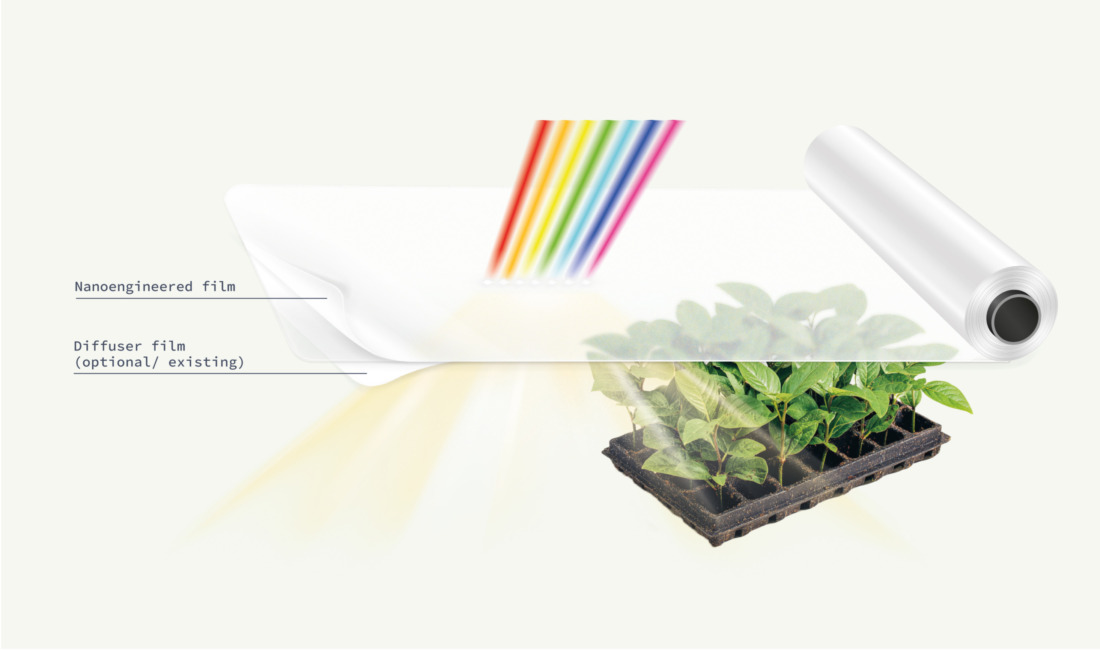
Turning “unused” sunlight into higher crop yield
The solar spectrum is very broad, yet plants only use part of it efficiently for photosynthesis. This portion of sunlight is referred to as Photosynthetically Active Radiation (PAR) and spans wavelengths from 400 to 700 nm.
In typical greenhouse conditions, a significant share of incoming UV and blue light is under-utilised for photosynthesis, while red light (≈600–650 nm) is known to strongly support photosynthesis, and growth response. Light quality plays a critical role in greenhouse productivity, and optimal spectral conditions can vary depending on crop type, climate zone, and growing strategy.
This creates a clear opportunity: improving how sunlight is spectrally distributed can increase the amount of light plants can actually use for growth.
About our technology
Based on our proprietary nanophosphor and light-conversion technologies, we are developing a light-conversion nanomaterial that reshapes incoming sunlight so crops receive a larger share of photosynthetically active light - without added energy use, electronics, or operational complexity.
Our focus is on converting largely under-utilised UV and blue light (<400–450 nm) into red light (≈600–650 nm). Using nano-engineered phosphors, we enable precise control over light conversion and emission, allowing tunable spectrum engineering tailored to different greenhouse strategies, crop types, and climate conditions.
Our class of material is well known for its strong thermal and photostability, properties that are particularly important for applications involving continuous light exposure, such as greenhouse environments.
Between these approaches, customised spectral solutions can be engineered to match specific application needs. Two complementary value propositions define the design space:
-
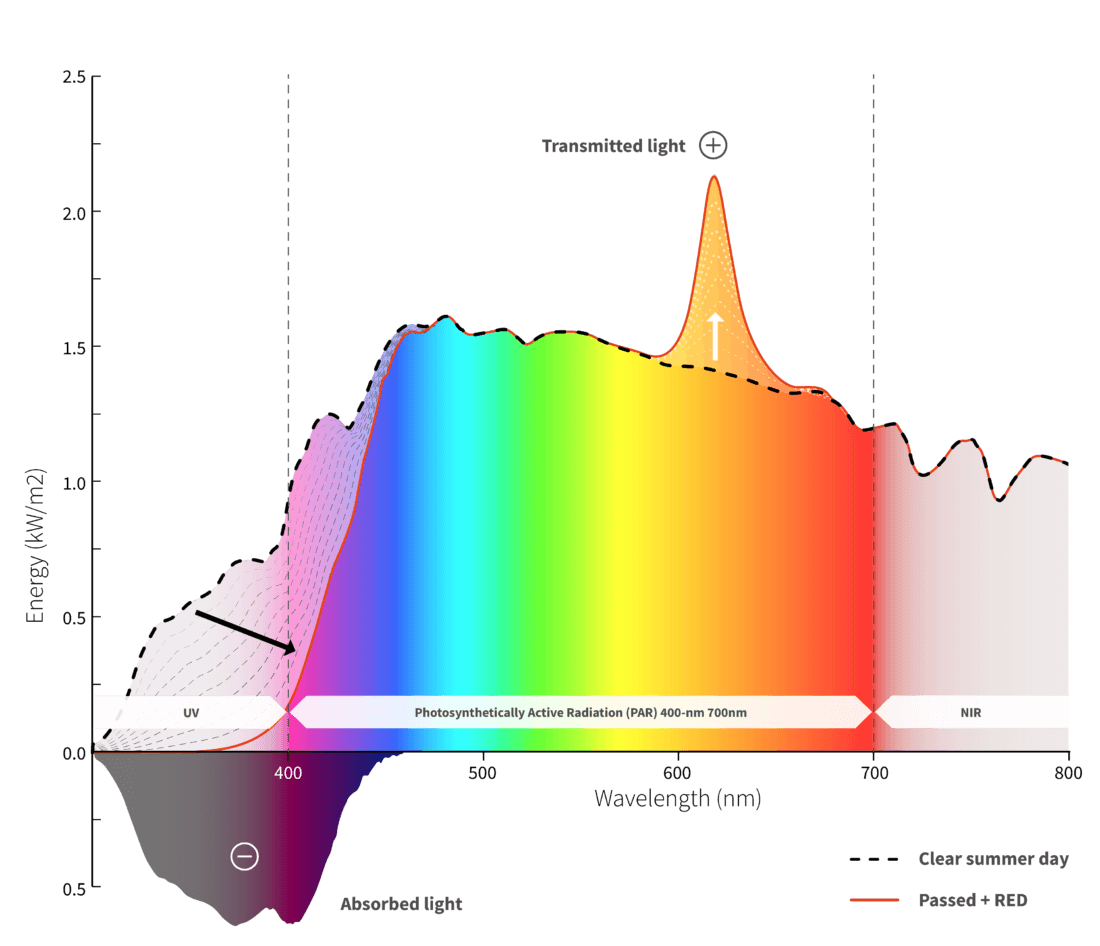
Red-shift strategy
Reshapes the spectrum to maximise growth response by enriching red light while keeping the total amount of PAR roughly neutral.
-
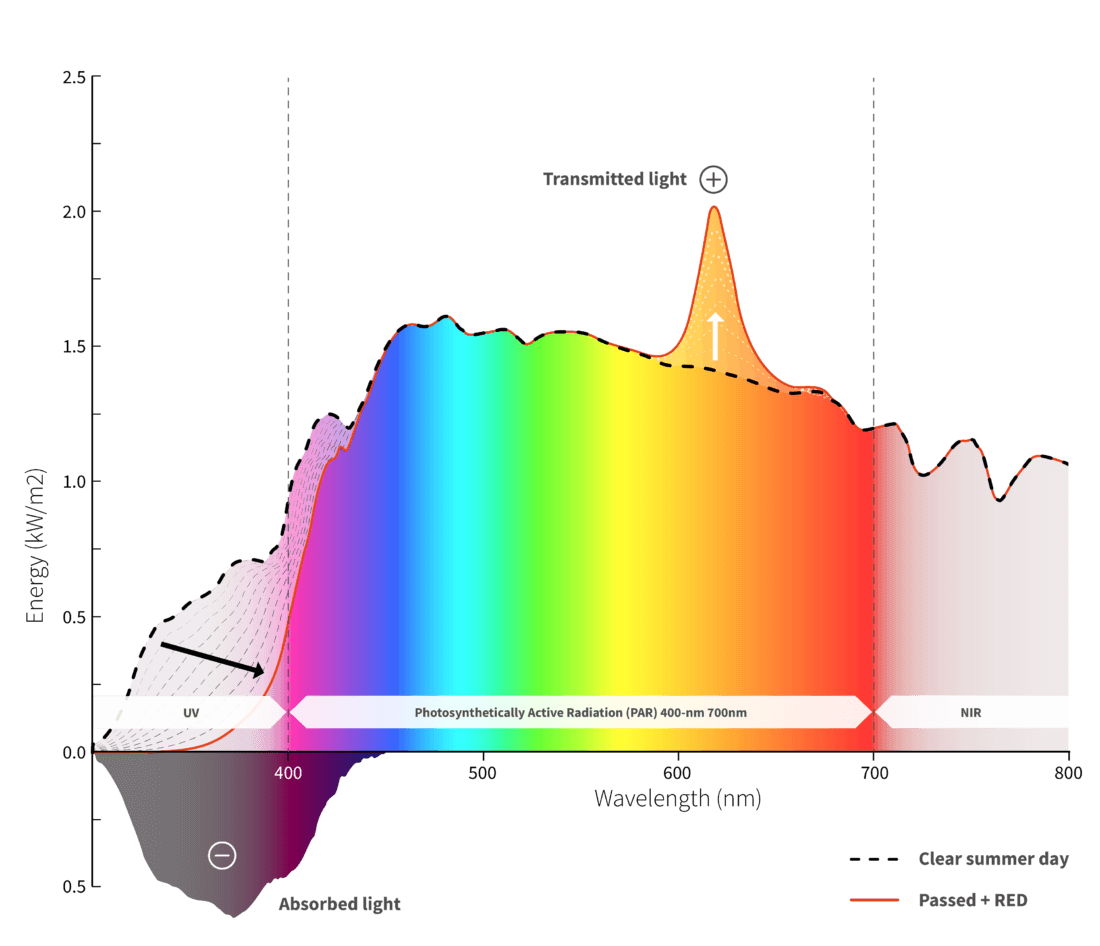
PAR+ strategy
Increases the total amount of photosynthetically active radiation delivered to plants by converting UV/blue light into PAR-useful wavelengths.
Integration-ready materials for greenhouse applications
Our nanophosphors are being engineered for integration into polymer-based greenhouse materials, where they can be incorporated as additives in polymer films or coatings used for greenhouse covers, inner films, or retrofit applications. This enables use in both plastic and glass greenhouses, with the light-conversion functionality implemented either directly in polymer films or as coating or laminate layers on glass, depending on the manufacturing route and substrate.
Looking to scale innovation together?
We are developing this technology for scalable greenhouse deployment and are currently seeking partnerships across films, glass, testing, trials, and recycling solutions.
Interested in exploring integration or collaboration?