Lumicrypt® can be integrated into a wide range of applications requiring authentication and brand protection. These include currency and banknotes, identity documents, luxury goods, packaging, pharmaceuticals, and secure product labelling.
Lumicrypt® for currency security
Seaborough delivers the next frontier in anti-counterfeit for banknotes through Lumicrypt®, an IFRET-based nanophosphor technology designed to align with modern cash-handling and inspection workflows, supporting multi-level authentication:
Level 1: Overt
Visible or easily verifiable elements under standard inspection conditions.
- Supports public confidence
- Enables fast validation in retail environments
- Enhances intuitive recognition
Level 2: Covert
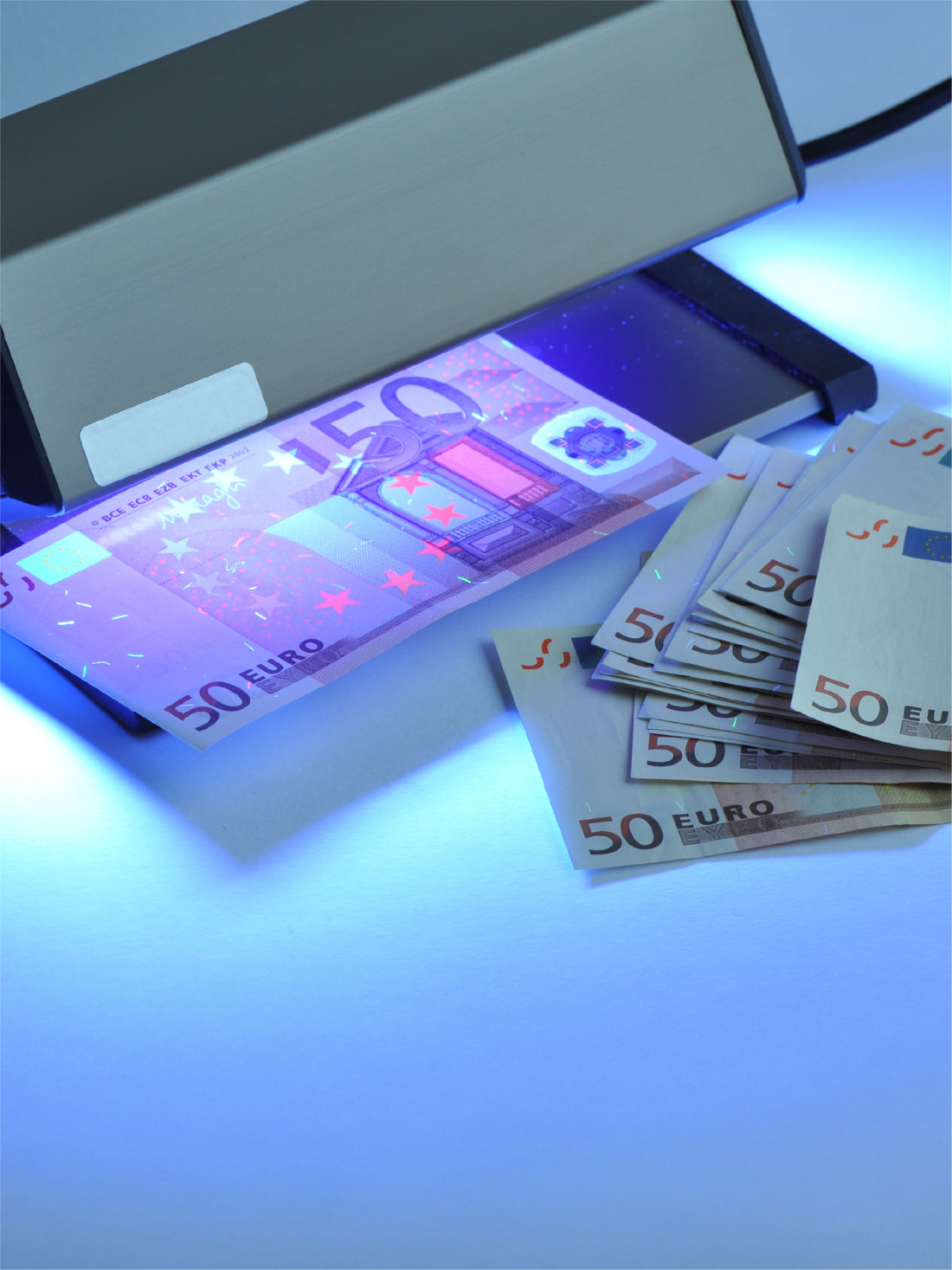
Features revealed under UV or specialized excitation
- Used by banks and cash-handling centers
- Compatible with automated sorting systems
- Designed for rapid machine verification
Level 3: Forensic
Highly specific emission characteristics and temporal optical signatures designed for laboratory-based authentication
- Laboratory-level verification
- Unique spectral fingerprinting
- Traceable and customizable to issuing authority
Designed for circulation
Banknotes are subjected to continuous folding, abrasion, moisture and prolonged exposure to light. Security features must remain stable under these demanding conditions.
Lumicrypt® is engineered to maintain consistent optical performance under heat, wear and extended circulation. The nano-engineered materials are designed to withstand handling stresses, ensuring reliable authentication throughout the operational lifetime of a banknote.
Stay ahead of counterfeiting with Lumicrypt®
Lumicrypt® empowers brands, governments and institutions to stay ahead of counterfeiting threats with advanced, resilient and future-proof optical security solutions. Contact Seaborough to explore how Lumicrypt® can be tailored to your anti-counterfeit strategy.
Key advantages of Lumicrypt®
- Highly specific optical signatures: Engineered emission and decay characteristics generate unique optical identifiers that are extremely difficult to replicate.
- Stable optical performance: Maintains consistent emission characteristics under prolonged exposure to light and heat, ensuring reliable authentication over time.
- Customizable to central bank specifications: Tailored excitation and emission profiles can be developed to meet unique national security requirements.
- Polymer and paper compatibility: Integrates into modern polymer substrates and traditional cotton-based banknotes.
Built for central banks and security printers
Lumicrypt® is purpose-built for high-security currency applications. Developed through advanced nanophosphor engineering, it delivers precise, stable, and customizable optical signatures tailored to the stringent requirements of central banks. Seaborough combines deep materials science expertise with scalable industrial production to ensure consistent performance from laboratory validation to full-scale banknote integration. Lumicrypt® is engineered for incorporation into existing security printing workflows, without disrupting established manufacturing processes.
Designed for collaboration across the currency ecosystem, Lumicrypt® supports:
- Central banks seeking next-generation anti-counterfeit protection
- Security printing companies integrating advanced optical features
- Currency technology providers enhancing authentication systems
- Cash-handling and inspection system manufacturers requiring machine-readable security
From development to deployment, Lumicrypt® delivers secure, scalable, and future-ready currency authentication. Contact Seaborough to discuss the secure integration of Lumicrypt® into currency and banknote programs.
Frequently asked questions about anti-counterfeit and banknote authentication
Find answers to the most common questions about anti-counterfeit solutions and banknote authentication. Learn how technologies like Lumicrypt® work, how they integrate into production, and what makes them secure. A clear overview to help you understand the possibilities and applications.
No. Lumicrypt® pigments are designed to integrate into inks, coatings or substrate without altering the appearance, texture, or design of the product, unless a customer specifically requests to the naked eye. This allows authentication features to be embedded without impacting brand aesthetics.
Lumicrypt® materials are engineered for long-term stability. Thanks to the inorganic composition, they maintain consistent optical performance under exposure to heat, UV light, and environmental stress, ensuring reliable authentication throughout the lifecycle of the product or document.
Lumicrypt® supports multiple levels of authentication. In many applications, verification can be performed using standard inspection tools such as UV lamps. For higher-security applications (Level 3 – forensic examination), additional verification is performed using analytical instruments that measure the optical signatures of materials, enabling professional, laboratory-grade authentication. Forensic document examination workstations, such as Video Spectral Comparators (VSCs) are equipped with built-in microspectrometers that can measure absorption, reflectance, and fluorescence spectra. These capabilities allow them to support Level 3 verification of Lumicrypt® by providing an objective and quantitative analysis.
Level 3 authentication provides forensic verification of Lumicrypt® materials. Under controlled excitation conditions, Lumicrypt® pigments produce highly specific optical signatures defined by their emission spectrum and temporal responses. These signatures act as a material “fingerprint” and can be analyzed using forensic or analytical instruments equipped with spectrometric detection. Modern forensic document examination systems include built-in microspectrometers capable of analyzing absorption, reflectance, and fluorescence spectra. By comparing the measured optical signature with the reference profile, experts can confirm the authenticity of the material with a high degree of certainty. Additional analytical techniques, such as Raman spectroscopy, may also be used to verify the material fingerprint in specialized forensic environments.
Yes. Lumicrypt® pigments are designed to work with standard ink formulations and common printing processes, allowing manufacturers to integrate the technology into existing production lines without significant process changes.
Nanophosphor-based systems generate highly specific optical signatures that are extremely difficult to replicate without access to the underlying materials and formulation processes. This makes them well suited for advanced anti-counterfeit applications.
Yes. Lumicrypt® pigments can be engineered to produce unique optical signatures tailored to a specific brand, product line, or document security program. This allows each application to incorporate a distinct authentication feature designed for its intended use.
Lumicrypt® supports a multi-level authentication approach commonly used in anti-counterfeit technologies.
· Level 1 (Overt): Features that can be verified by the public through simple visual inspection.
· Level 2 (Covert): Features revealed using standard inspection tools such as UV illumination.
· Level 3 (Forensic): Advanced material signatures that can be verified using specialized analytical equipment in laboratory environments.
This layered structure enables authentication at different stages, from quick inspection in the field to detailed forensic verification.